Showing posts with label Thai. Show all posts

Tuesday, March 30, 2010

S&I Thai

The essence of Thai food is a balance of sweet, salty, sour, spicy and, more occasionally, bitter. Unfortunately, what we get in restaurants is frequently one-dimensional simply sweet, or "level 10 spicy." Thankfully, John and I found S&I Thai, a takeout dive in Allston that cooks just like the best of what we had in Bangkok. They don't wimp on the chilli fire or any of the other taste elements that make Thai cuisine so wonderful.

Order off the pictures on the walls rather than the printed menu. If you don't know what something is, just point or ask. Be sure to get one of their "crispy pork" dishes, such as the pad ga pow moo krob pictured here. They expertly fry the fatty cuts of pork, leaving it crispy and savory, then stud it with chillis and basil. The Thai barbecued chicken with sticky rice is also to die for. Order it with a side of som tam (papaya salad).

Final note: S&I is very easy on the wallet. Entrees are $8 or $9, so go ahead, finish off the meal with a mango over sticky rice.

Sunday, March 28, 2010

Pad thai

Pad thai has gotten a reputation as the thing that unadventurous Americans always order at Thai restaurants, but it's actually an excellent dish. Who could not love comforting rice noodles and shrimp stir-fried with sweet, salty and sour flavors, topped with ground peanuts and fresh green onions?

Well okay, actually I have had a number of bad restaurant versions, achingly sweet and/or suspended in thick, gooey sauce. Kasma Loha-Unchit, a Thai cooking instructor in San Francisco, explains that the gooey restaurant texture that many Americans have come to prefer is achieved through tomato ketchup. Kasma's recipe, which inspired my version below, is drier than the typical restaurant pad thai, with a complex range of flavors and textures.

Pad thai is made with bean sprouts, which neither John nor I like. I am slightly allergic and he considers them "barely food," so I have omitted them here. If you like, add a handful to the wok in step 7.

1. Soak 1/2 pound of dried rice noodles in hot water for 30 minutes (while you do the prep in steps 2 and 3) until noodles are limp but still firm to the touch. Drain.

2. Mix 3 T. fish sauce, 3 T. tamarind juice, and 2 T. palm or white sugar. Taste and adjust seasonings to achieve a balance of salty, sweet and sour.

3. Peel and devein 1/3 pound of shrimp. Cut 3/4 cup of firm pressed tofu (found in any Asian grocery) into matchsticks. Mince 4-5 garlic cloves and thinly slice 3 shallots. Cut 5 scallions or garlic chives into 1 1/2-inch segments. Cut a lime into wedges. Crush 2/3 cup roasted peanuts. Measure out 1/4 cup dried shrimp and 2-3 T. ground chillis.

4. Heat a wok until it smokes, add a bit of peanut oil, and quickly stir-fry the shrimp just until they turn pink. Sprinkle them with fish sauce and remove from the wok.

5. Add the tofu to the wok, frying 1-2 minutes until golden. Add the garlic and shallots, then the dried shrimp and ground chillis.

6. Now add the drained noodles, tossing well with the other ingredients. Once the noodles have changed texture and softened, push the mass up along one side of the wok. Add a bit of oil to the cleared area, crack 3 eggs onto it, and scramble lightly. Once they have set, toss them in with the noodles.

7. Add the sweet and sour seasoning mixture, stirring well to coat the noodles evenly. Adjust the flavors. Add the scallions or chives, the shrimp and half the peanuts to the wok. When the greens are slightly wilted, transfer to a serving platter and garnish with the rest of the peanuts and the lime wedges.

Tuesday, March 2, 2010

Fried rice two ways

Whenever John and I made too much rice, we used to stupidly throw away the leftover bits at the bottom of the pot. Now we save them up for fried rice, which must be cooked with cold rice or it comes out mushy. Fried rice is beautiful — it's quick, delicious, colorful and can be made with whatever meat or vegetables you've got.

First up is Mandarin fried rice, adapted from Grace Young's Breath of a Wok. This dish uses lap xuong, the sweet, fatty Chinese sausage found in any Asian grocery. Lap xuong evokes major childhood nostalgia for me. My grandmother sliced it, fried it up and served it to me over sticky rice, the hot fragrant grease sinking through the rice to permeate every grain. As an adult, I noticed that the second ingredient is pork fat. To save our arteries, I bought the "extra lean" kind.

1. Thinly slice 1 Chinese sausage. Mince a few cloves of garlic and an equal amount of ginger. Slice 2-3 scallions thinly.

2. Beat 2 eggs. Heat a wok until smoking, then swirl in 1 T. peanut oil and 1 tsp. sesame oil. Tip in the eggs and tilt the wok so that the eggs cover the surface as thinly as possible to make a pancake. When the pancake is just set, turn it onto a cutting board and slice it into shreds.

3. Reheat the wok with another T. of peanut oil. Add the garlic and ginger and stir-fry 30 seconds. Add the sausage and stir-fry 1 minute. Add the scallions and 2-3 cups of cold cooked rice, breaking up large chunks of rice. Add a splash of Shaoxing rice wine and stir-fry 2-3 minutes until heated through. Season with soy sauce and white pepper, add the egg shreds, and toss to combine. Feeds 2.

The second version is Thai basil fried rice, very loosely adapted from Kasma Loha-Unchit's recipe.

1. Cut 1/2 lb. chicken or pork into small pieces and sprinkle with fish sauce. Chop 6 cloves of garlic and 2 Thai chillis. Thinly slice 3-4 shallots.

2. Heat a wok until smoking and swirl in 1 T. peanut oil. Add the meat, leaving undisturbed for a minute to brown, then add the garlic, chillis and shallots. Stir-fry a couple minutes until meat is cooked and vegetables slightly browned.

3. Add 2-3 cups cold cooked rice and stir-fry until rice is softened and has begun to brown. Add 2 T. black soy sauce and toss to coat the rice. Season with fish sauce, then remove from heat, stir in a cup of Thai basil leaves and sprinkle liberally with white pepper. Serve with a wedge of lime. Feeds 2.

Sunday, February 28, 2010

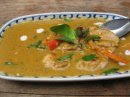
Red curry chicken

For a really full-bodied curry, there's nothing like pounding your own curry paste. John and I had so much fun doing this at Thai cooking school that I came home and bought a mortar and pestle straight away. We made a wicked green curry in December that burned our throats and made us cry. It was delicious as it was evil.

I had been wanting to try a red curry ever since. Red curry is tamer than green, as it uses ripened red chillis instead of the hotter green ones. I finally worked up the motivation yesterday when I spotted these little Thai eggplants at the Super 88 in Dorchester. Called turtle eggplants for their shape and coloration, these slightly bitter gems play wonderfully against the sweet tang of curry. We ate them everywhere in Bangkok and Chiang Mai, but they can be hard to find in the U.S. I have also used the long Asian eggplants in curries, which are not as bitter but still lovely.

Making curry is nothing more than gathering the ingredients and giving your arm a good workout. If you don't have a mortar, paste can also be achieved with a coffee grinder and food processor. Most everything here is available in Asian groceries or an online store like Temple of Thai, but one thing I cannot lay my hands on in Boston is fresh kaffir lime. In place of this, substitute equal amounts of regular lime zest and minced kaffir lime leaf.

1. Throw 1 T. coriander seeds and 2 cardamom pods into your wok or saucepan and roast them over medium heat until browned. Put these into a mortar (or coffee grinder) with 1/2 tsp. black peppercorns and 1/2 tsp. salt and grind to a fine powder.

2. Cut 10 big red dried Thai chillis in half and shake out the seeds. Soak these in water at least 10 minutes and chop them finely.

3. Mince the following ingredients fine (or chop them in the food processor): 1 tsp. galangal, the lower third of 1 lemongrass stalk, 1 tsp. kaffir lime peel, 1 T. cilantro, 3 T. shallots, 3 T. garlic, 1 tsp. shrimp paste, 10 small red Thai chillis.

4. Now add those ingredients to the mortar and pummel it all into a fine, red paste (or transfer the spices from the grinder to the food processor and puree). This makes 4-5 T., enough for one curry dish, so you may want to double it for another time.

Now for the chicken dish:

1. Cut a pound of chicken breast or thigh meat into small pieces. Season with fish sauce and white pepper.

2. Heat 2 T. peanut oil in a wok and fry 4 T. curry paste until hot and fragrant. Add 1 can coconut milk, reserving a bit for garnish, and bring to a boil. Add 8-10 Thai eggplants, halved or quartered, and simmer a few minutes until soft. Season with fish sauce and palm sugar to taste.

3. Add the chicken pieces and 2 kaffir lime leaves. Simmer a few more minutes until chicken is white and cooked through. Add some water to desired consistency.

4. Stir a handful of Thai basil leaves and transfer the curry to a platter. Garnish with more basil leaves, chillis, and dashes of coconut milk.

Wednesday, February 17, 2010

Tom ka gai

Tom ka gai soup, with its creamy coconut base and tangy flavor, is one of my top comfort foods. We made it in my cooking class in Chiang Mai last fall. It's quite quick and easy, but does require a couple ingredients hard to find in my part of the world - kaffir lime leaf and galangal. (I have both frozen, which I ordered fresh from www.templeofthai.com.)

Note that the galangal, lemongrass segments, chillis, and kaffir lime leaf are not meant to eaten, but used to flavor the broth. You can keep these in for presentation, especially the chillis, but restaurants tend to strain them out.

Adapted from Sompon Nabnian's Chiang Mai Thai Cookery School cookbook:

1. Cut the bottom third of a lemongrass stalk into 1-inch segments. Slice four thin coins off a piece of galangal. Tear two kaffir lime leaves into pieces. Put all these in a wok with 1 1/2 cups coconut milk, 1 1/2 cups water, and 4 to 5 red thai chillis. Bring to a boil, simmer 10 minutes and strain, if desired.

2. Return the liquid to the wok and add 6 ounces thinly sliced raw chicken breast, a cup of straw mushrooms, and 4 thinly sliced shallots. Season with fish sauce and bring back to a boil. Add a handful of chopped cilantro and turn off the heat. Stir in the juice of a lime. Serve garnished with thinly sliced scallions and extra cilantro.

Friday, February 12, 2010

Thai steamed banana cake

I had a bunch of bananas that were going downhill, so I decided to make the steamed banana cake John and I had made in our cooking class in Chiang Mai. Sticky, pleasingly sweet, and very easy.

1. Mash 3 bananas in a mixing bowl and add 1 cup unsweetened coconut, 1/2 cup sugar, 1/2 cup rice flour, 1/8 cup tapioca flour, 1/4 cup coconut milk, and a pinch of salt. Mix well.

2. Divide the mixture among four ramekins or small bowls and sprinkle some more coconut on top. Steam for 30 minutes and serve hot or cold.

Friday, December 25, 2009

Gaprow

The other night I made gaprow, the Thai stir-fry of minced meat, chilli and basil. This actually was not a dish I learned at Thai cooking school, but the recipe was in this month's Cook's Illustrated. Unlike in the classic stir-fry method where you add cold oil to a scorching hot pan, it involves sauteing the aromatics over low heat at the beginning to infuse the meat with full flavor during the stir fry. This was such an easy and beautiful meal, to table in less than 20 minutes. The recipe is supposed to serve four — maybe alongside other Thai dishes — but two piggies would eat it all up.

1. Chop a cup of Thai basil leaves, 5 or so garlic cloves, and 6-10 green or red Thai chillis (green is hotter, red prettier in this dish) in the food processor. Transfer 1 T. of this mix to a bowl and stir in 1 T. fish sauce, 1 T. oyster sauce, 1 T sugar and 1 tsp. white vinegar. Put the rest of the basil mix in a wok or skillet. Do not wash food processor.

2. Now cut a pound of chicken breast into smallish pieces. Pulse these in the food processor with another T. of fish sauce until the meat is chopped small (but not as fine as commercial ground meat).

3. Slice three shallots thinly and add these and 2 T. veg oil to the wok. Heat over medium-low, stirring, 5 minutes to brown garlic and shallots.

4. Turn the heat up to medium-high and add the chicken. Stir-fry for 2-3 minutes, breaking up the meat until just traces of pink remain, then add reserved basil-sauce mixture and cook another minute until chicken is done. Taste and adjust seasonings. Stir in another cup of basil leaves until just wilted and serve.